
Cyber Security and Digital Forensics MSc (Distance Learning)
Start Dates
7 September 2026, 18 January 2027, 10 May 2027
Duration
2-3 years part-time
Watch a Webinar
Register for our next live event or watch an on-demand webinar
Overview
Why choose Huddersfield for this course?
- Gain advanced expertise across three critical areas: cyber security, digital forensics and artificial intelligence.
- Learn from our research-active academic staff, who bring real world insight and the latest research directly into their teaching.
- Taught 100% online, part-time allowing you to study while working.
Accreditation and Professional Links
Recognised connections to give you an extra edge when you graduate. Read More
Cyber threats are becoming more frequent, more sophisticated and more damaging. Our 100% online Cyber Security and Digital Forensics MSc prepares cyber professionals and graduates with a computing background to respond to this challenge, by developing the skills needed to protect systems, investigate digital incidents and work effectively with digital evidence.
On the course, you will build technical and analytical capability across cyber defence and digital investigation. You will study secure-by-design engineering, threat modelling and risk assessment, alongside digital forensics techniques that support the identification, acquisition, preservation and analysis of digital evidence. You will also learn how ethical hacking and applied cryptography are used to test, strengthen and assure modern IT systems.
A defining feature of the MSc is its integration of cyber security, digital forensics and artificial intelligence, enabling you to develop fluency in the application of AI to security and forensic challenges. You will examine how AI and machine learning can support threat detection, triage and forensic analysis, while critically assessing challenges such as robustness, bias and governance. The course concludes with an independent project focused on a contemporary cyber security or digital forensics problem, enabling you to demonstrate professional, research and problem-solving skills relevant to roles across industry, law enforcement and the public sector.
Learn more about Distance Learning at Huddersfield.
We also offer this course as a full-time on-campus route.
Career opportunities after the course *
Software Engineer
Network Engineer
Security Engineer
Infrastructure Engineer
Solutions Architect
*Lightcast
Entry Requirements
Entry requirements for this course are normally:
- A BSc or BEng Honours degree (2:2 or above) in Computing or related subject or an equivalent professional qualification. For applicants who received their degree more than 10 years ago, we will need evidence to demonstrate current knowledge in the subject area, such as reference letters, training certificates or significant relevant work experience.
- Other qualifications and/or experience that demonstrate appropriate knowledge and skills at an Honours degree level.
- Substantial (3 years) relevant industry experience.
If your first language is not English, you will need to meet the minimum requirements of an English Language qualification. The minimum of IELTS 6.0 overall with no element lower than 5.5, or equivalent or Duolingo English certificate, score 105 or above. Read more about the University’s entry requirements for students outside of the UK on our International Entry Requirements page.
Course Details
Teaching and Assessment
Discover what to expect from your tutor contact time, assessment methods, and feedback process.
Technology and System Requirements
As a Distance Learning student, you must provide and have access to certain IT equipment and facilities to access your Virtual Learning Environment (VLE) and to fully participate on your course.
Your Career
The top five job titles advertised in the UK for graduate roles associated with Cyber Security and Digital Forensics MSc courses are: Software Engineer, Network Engineer, Security Engineer, Infrastructure Engineer; and Solutions Architect.
Source: LightcastTM data - job postings from December 2023 to December 2024 showing jobs advertised associated with a selection of relevant graduate roles.
98% Percentage of our postgraduate students go on to work and/or further study within fifteen months of graduating.
* HESA Graduate Outcomes 2022/23, UK domiciled.
£38.5k Average salary of our postgraduate students fifteen months after graduating.
* HESA Graduate Outcomes 2022/23, mean salary, UK domiciled, full-time UK employment as main activity.
The diversity and depth of modules in this course allowed for engaging and comprehensive learning, and enabled me to impart a broad understanding onto my new job in the Incident Response team at BT.
- Eoghan Ó Tiománaidhe
Cyber Security and Digital Forensics MSc Graduate
Fees and Finance
This information is for Home and International students applying to study at the University of Huddersfield in the academic year 2026/27.
Modules credits can range from 15 to 60, dependent on the content of the module. Read more about total credits required for a range of degrees, to allow you to calculate the potential total cost.
Please note that tuition fees for subsequent years may rise in line with inflation (RPI-X) and/or Government policy and/or to ensure our distance learning fees are competitive.
Tuition fees will cover the cost of your study at the University. Read more about what is and is not covered by Tuition Fees including compliance for Goods and Services Tax for International Students studying an online course.
For detailed information please visit www.hud.ac.uk/distance-learning/fees-and-finance/
This information is for Home and International students applying to study at the University of Huddersfield in the academic year 2026/27.
Modules credits can range from 15 to 60, dependent on the content of the module. Read more about total credits required for a range of degrees, to allow you to calculate the potential total cost.
Please note that tuition fees for subsequent years may rise in line with inflation (RPI-X) and/or Government policy and/or to ensure our distance learning fees are competitive.
Tuition fees will cover the cost of your study at the University. Read more about what is and is not covered by Tuition Fees including compliance for Goods and Services Tax for International Students studying an online course.
For detailed information please visit www.hud.ac.uk/distance-learning/fees-and-finance/
Funding options
Explore ways to fund your course with exclusive discounts and government loans (subject to eligibility criteria)
Read moreIf you have any questions about Fees and Finance, please email the Student Finance Team.
Explore More
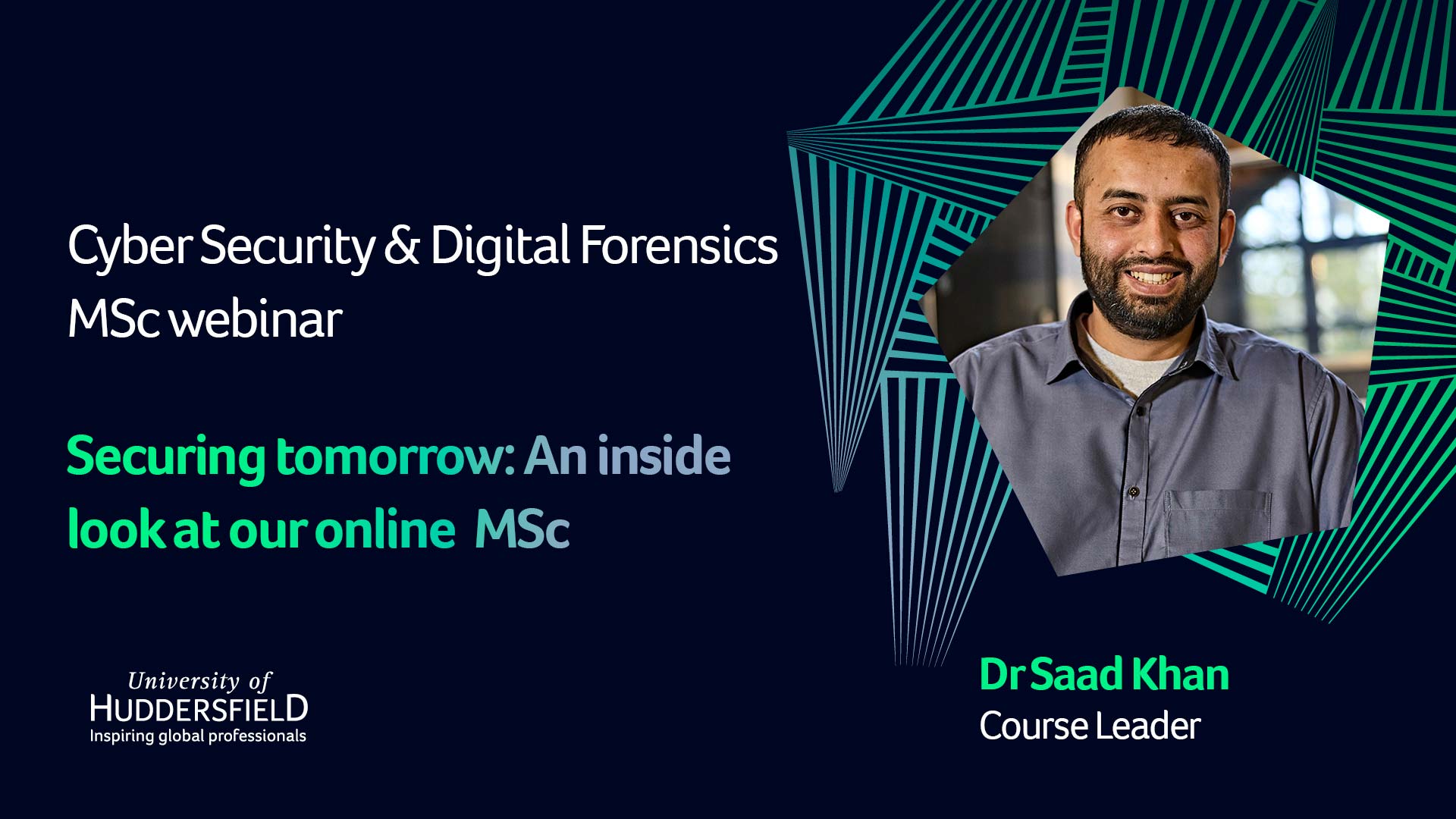
Watch our on-demand webinar
Join Dr Saad Khan, Senior Lecturer and Course Leader, to explore our online Cyber Security & Digital Forensics MSc. In this webinar, you'll dive into the course content and key benefits of studying with it with us.

UK Cyber Retail Attacks
Why Cyber Security Skills Are More Vital Than Ever: Lessons from the Latest UK Retail Attacks Recent cyber attacks on major UK retailers highlight the urgent need for cyber experts. Dr Professor Simon Parkinson, Director of the Centre for Cyber Security and a member of the UK Government’s Cyber Security Advisory Board discusses these challenges and how University of Huddersfield cyber courses are educating the next generation of digital defenders

What our students say...
"I believe this is the best course on the market. It aligns perfectly with my career aspirations in Cyber Security and Digital Forensics. Its flexible structure allows me to balance work and study. The comprehensive content and practical knowledge enriched my IT role and prepared me for future opportunities. With engaging learning materials and a supportive environment, this MSc has been both enjoyable and invaluable, setting me on a confident path toward my career goals." - Aidan Froggatt, Cyber Security and Digital Forensics MSc (Distance Learning) student, IT Service Desk Analyst at Sudlows

Why work in Cyber Security?
Cyber Security professionals are in high demand in the UK. With attractive salaries and varied growth opportunities, this field offers a chance to make a real-world impact by protecting organisations from cyber-attacks and unauthorised access. Read our blog to learn more.

Student profiles
Discover what our distance learning students have to say about their experiences at the University of Huddersfield by checking out their profiles.
Why Hud
Explore the unique opportunities and resources that make our institution a top choice for students seeking a well-rounded and future-focused education.

Teaching Excellence
Our online courses are delivered by the same highly qualified academic staff who teach in-person at the University of Huddersfield. This means you’ll benefit from the same high standards in teaching excellence as our on-campus students.
Learn more
Affordable Study
Online study can be a cost effective way to obtain a prestigious qualification. There are no travel, accommodation or visa expenses and we don’t charge application or administrative fees. Plus, you can pay our competitive tuition fees in instalments, and spread the costs over time.
Learn more
Your Student Experience
Our online courses are designed to be interactive, engaging and inclusive. You’ll have the freedom to learn at your own pace, in your own time, while benefiting from live sessions and contact time with your Module Tutor, Personal Academic Tutor, Academic Skills Tutor and/or Project Supervisor.
Learn more
Graduate on campus
Our Distance Learning students are invited to our in-person graduation ceremonies so you can celebrate your success and meet your tutors and classmates. You’ll also have the opportunity to explore our beautiful campus.
Learn more
Reduced Inequalities
We’re ranked 1st in the world for Reduced Inequalities in the Times Higher Education Impact Rankings 2025, which celebrate commitment to the Sustainable Development Goals set by the United Nations.
Read moreMore Info
Careers support
We know you’re coming to university to study on your chosen subject, meet new people and broaden your horizons. However, we also help you to focus on life after you have graduated to ensure that your hard work pays off and you achieve your ambition.
Find out more about careers supportStudent support
At the University of Huddersfield, you will find support networks and services to help you get ahead in your studies. Our Distance Learning Unit Team are at hand to make your online learning journey a positive, rewarding and successful one.
Click for more infoTeaching Excellence
Great teaching is engaging and inspiring — it helps you reach your full potential and prepares you for the future. We don’t just teach well — we excel — and we have the awards and recognition to prove it.
Find out moreInspiring Academics
Our researchers carry out world-leading work that makes a real difference to people’s lives. Staff within the Department of Computer Science may teach you on this course.
Find out more about our staffResearch Excellence
You’ll be taught by staff who want to support your learning and share the latest knowledge and research.
Find out moreFurther Study
Many of our graduates stay at Huddersfield to complete postgraduate research degrees at Masters or PhD level.
Discover research degreesLegal information
When you enrol as a student of the University, your study and time with us will be governed by our terms and conditions, Handbook of Regulations and associated policies. It is important that you familiarise yourself with these as you will be asked to agree to them when you join us as a student. You will find a guide to the key terms here, along with the Student Protection Plan.
Although we always try and ensure we deliver our courses as described, sometimes we may have to make changes for the following reasons:
Changes to a course you have applied for but are not yet enrolled on
If we propose to make a major change to a course that you are holding an offer for, then we will tell you as soon as possible so that you can decide whether to withdraw your application prior to enrolment. We may occasionally have to withdraw a course you have applied for or combine your programme with another programme if we consider this reasonably necessary to ensure a good student experience, for example if there are not enough applicants. Where this is the case we will notify you as soon as reasonably possible and if you are unhappy with the change we will discuss with you other suitable courses we can transfer your application to. If you do not wish to transfer to another course with us, you may cancel your application and we will refund you any deposits or fees you have paid to us.
Changes to your course after you enrol as a student
Changes to option modules
Where your course allows you to choose modules from a range of options, we will review these each year and change them to reflect the expertise of our staff, current trends in research and as a result of student feedback or demand for certain modules. We will always ensure that you have an equivalent range of options to that advertised for the course. We will let you know in good time the options available for you to choose for the following year.
Major changes
We will only make major changes to non-optional modules on a course if it is necessary for us to do so and provided such changes are reasonable. A major change is a change that substantially changes the outcomes, or a significant part of your course, such as the nature of the award or a substantial change to module content, teaching days (part time provision), type of delivery or assessment of the core curriculum. For example, it may be necessary to make a major change to reflect changes in the law or the requirements of the University’s regulators or a commissioning or accrediting body. We may also make changes to improve the course in response to student, examiners’ or other course evaluators’ feedback or to ensure you are being taught current best practice. Major changes may also be necessary because of circumstances outside our reasonable control, such as a key member of staff being unable to teach due to illness, where they have a particular specialism that can’t be adequately covered by other members of staff; or due to pandemics, other disasters (such as fire, flood or war) or changes made by the government.
Major changes would usually be made with effect from the next academic year, but may happen sooner in an emergency. We will notify you as soon as possible should we need to make a major change and will consult with affected groups of students and any changes would only be made in accordance with our regulations. If you reasonably believe that the proposed change will cause you detriment or hardship we will, if appropriate, work with you to try to reduce the adverse effect on you or find an appropriate solution. Where an appropriate solution cannot be found and you let us know before the change takes effect you can cancel your registration and withdraw from the University without liability to the University for any additional tuition fees. We will provide reasonable support to assist you with transferring to another university if you wish to do so and you may be eligible for an exit award depending on how far through your course you are.
In exceptional circumstances, we may, for reasons outside of our control, be forced to discontinue or suspend your course. Where this is the case, a formal exit strategy will be followed in accordance with the student protection plan.
The Office for Students (OfS) is the principal regulator for the University.