
Artificial Intelligence PgDip (Distance Learning)
Start Dates
6 September 2027, 17 January 2028, 8 May 2028
Duration
2 years part-time
Application deadlines
- September Entry - Application Deadline: 30 August
- January Entry - Application Deadline: 10 January
- May Entry - Application Deadline: 1 May
Overview
Why choose Huddersfield for this course?
- Explore hybrid AI systems: how AI learns from data and how it reasons with knowledge.
- Develop advanced skills to design, implement and evaluate intelligent systems responsibly and ethically.
- Taught 100% online, part-time allowing you to study while working.
Our 100% online Postgraduate Diploma (PgDip) is designed for graduates with a background in computer science or relevant professional experience who want to develop advanced expertise to design, implement, and critically evaluate intelligent systems that underpin modern technological innovation.
Our specialist course brings together both data-driven approaches - such as machine learning, deep learning and generative AI - with knowledge-based approaches including automated reasoning, planning, knowledge representation and intelligent control. This integrated approach enables you to understand not only how hybrid AI systems achieve performance, but how their decisions are structured, interpreted, justified and trusted.
You’ll gain a deep understanding of the principles and computational techniques that enable intelligent behaviour in machines. Throughout the course you’ll learn to select appropriate AI methods for complex, real-world challenges, evaluate their performance and limitations, and implement working systems using contemporary AI frameworks and tools such as Python and MATLAB.
This course aims to prepare you for careers in AI, robotics, autonomous systems, intelligent decision support, and related fields.
Learn more about Distance Learning at Huddersfield.
Career opportunities after the course *
Data Scientist
Machine Learning Engineer
Data Engineer
Software Engineer
Data Analyst
*Lightcast
Entry Requirements
Entry requirements for this course are normally:
- A BSc or BEng Honours degree (2:2 or above) in Computing or Engineering or related subject or an equivalent professional qualification. For applicants who received their degree more than 10 years ago, we will need evidence to demonstrate current knowledge in the subject area, such as reference letters, training certificates or significant relevant work experience.
- Other qualifications and/or experience that demonstrate appropriate knowledge and skills at an Honours degree level.
If your first language is not English, you will need to meet the minimum requirements of an English Language qualification. The minimum for IELTS is 6.0 with a minimum score of 6.0 in writing and a minimum of 5.5 in any single component or Duolingo English certificate, score 105 or above. Read more about the University’s entry requirements for students outside of the UK on our International Entry Requirements page.
Course Details
Teaching and Assessment
Discover what to expect from your tutor contact time, assessment methods, and feedback process.
Technology and System Requirements
As a Distance Learning student, you must provide and have access to certain IT equipment and facilities to access your Virtual Learning Environment (VLE) and to fully participate on your course.
Your Career
Graduates of the Artificial Intelligence MSc can progress into a range of data-driven and technical roles across sectors including technology, finance, healthcare, engineering and creative industries. Many go on to work as Data Scientists, Data Engineers, Data Analysts, Software Engineers or Research Scientists, applying AI techniques to solve real-world challenges. There is also demand for specialist leadership positions such as Data Science Manager. As AI continues to transform the global job market, knowledge and experience of AI systems are increasingly valued across many professional fields, opening pathways beyond traditional technology roles.
Source: Lightcast data extracted from the Graduate Career Explorer
98% of our postgraduate students go on to work and/or further study within fifteen months of graduating.
* HESA Graduate Outcomes 2022/23, UK domiciled.
£38,500 Average salary of our postgraduate students fifteen months after graduating.
* HESA Graduate Outcomes 2022/23, mean salary, UK domiciled, full-time UK employment as main activity.
My time at Huddersfield was instrumental in advancing my career. The course gave me the confidence and skills to address complex challenges in AI & software engineering. The skills helped me adapt to emerging technologies and remain at the forefront of my field.
- Marco Dinacci
Artificial Intelligence MSc Graduate
Technical Lead at Apple
Fees and Finance
This information is for Home and International students applying to study at the University of Huddersfield in the academic year 2026/27.
Modules credits can range from 15 to 60, dependent on the content of the module. Read more about total credits required for a range of degrees, to allow you to calculate the potential total cost.
Please note that tuition fees for subsequent years may rise in line with inflation (RPI-X) and/or Government policy and/or to ensure our distance learning fees are competitive.
Tuition fees will cover the cost of your study at the University. Read more about what is and is not covered by Tuition Fees including compliance for Goods and Services Tax for International Students studying an online course.
For detailed information please visit www.hud.ac.uk/distance-learning/fees-and-finance/
This information is for Home and International students applying to study at the University of Huddersfield in the academic year 2026/27.
Modules credits can range from 15 to 60, dependent on the content of the module. Read more about total credits required for a range of degrees, to allow you to calculate the potential total cost.
Please note that tuition fees for subsequent years may rise in line with inflation (RPI-X) and/or Government policy and/or to ensure our distance learning fees are competitive.
Tuition fees will cover the cost of your study at the University. Read more about what is and is not covered by Tuition Fees including compliance for Goods and Services Tax for International Students studying an online course.
For detailed information please visit www.hud.ac.uk/distance-learning/fees-and-finance/
Funding options
Explore ways to fund your course with exclusive discounts and government loans (subject to eligibility criteria)
Read moreIf you have any questions about Fees and Finance, please email the Student Finance Team.
Explore More
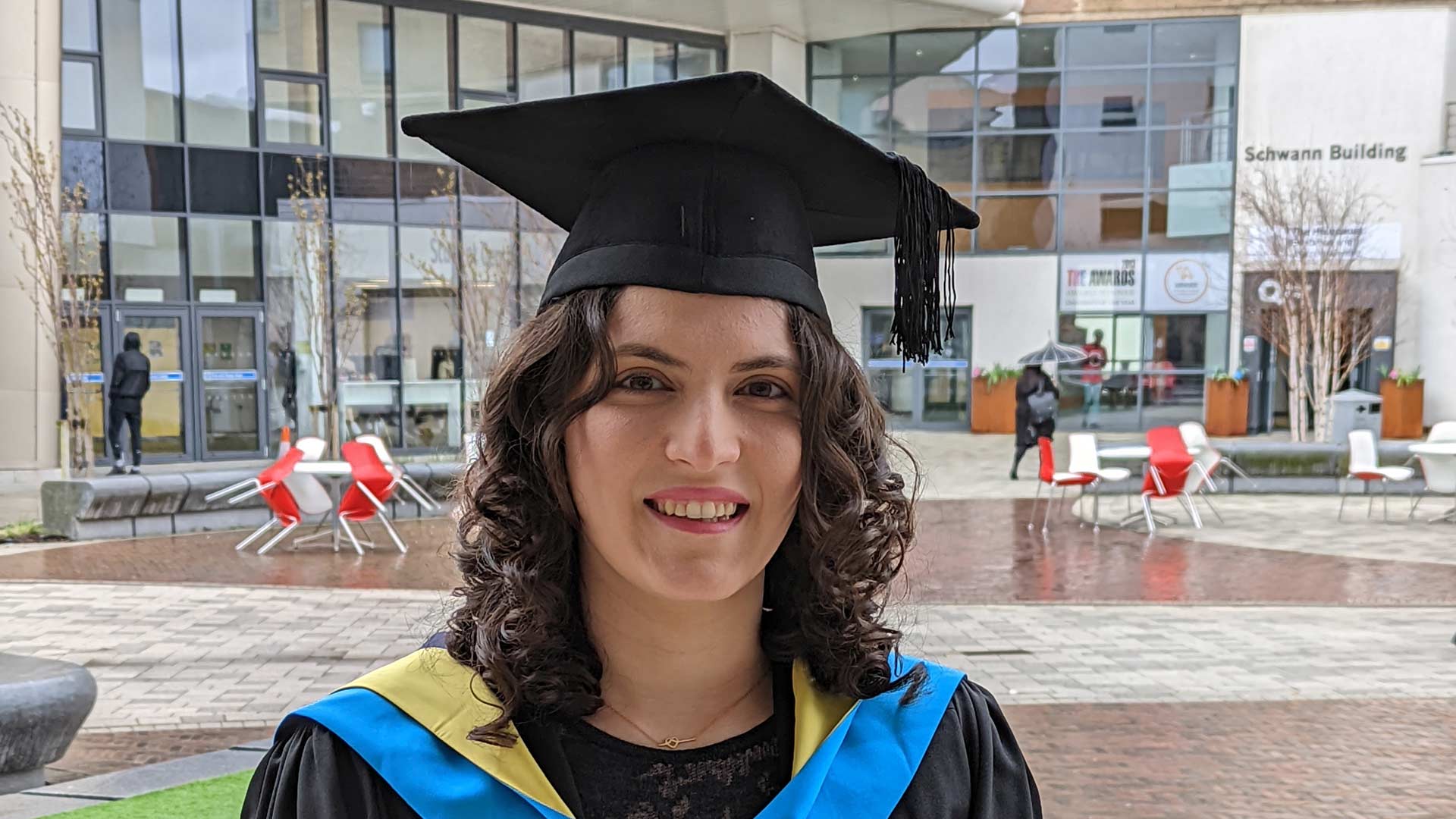
What our graduates say…
"The quality of teaching on the AI Master's course at Huddersfield was notably high. What stood out for me was not just the academic rigour, but also the amicable nature of the teaching staff. They were always accessible and willing to engage, whether it was to clarify my doubts or to help me delve deeper into a topic. The overall responsiveness and dedication of the School of Computing and Engineering significantly contributed to my understanding and appreciation of Artificial Intelligence." - Fuzhan Rahmanian, Artificial Intelligence MSc (Distance Learning) graduate.

Distance Learning Blog
Learn more about distance learning by visiting our blog, where students, staff, and academics share valuable insights on a wide range of interesting topics.

Sign up for emails
Find out more about Distance Learning at Huddersfield and stay updated with the latest news and events.

The Institute for Applied Artificial Intelligence
The Institute is a cross-disciplinary hub driving innovation in applied AI, connecting research, industry partnerships and real-world impact.