
Paramedic Science (Degree Apprenticeship) BSc(Hons)
This apprenticeship is employer led: applications must be submitted by employers on behalf of their staff.
Start Dates
21 September 2026, 15 March 2027
Duration
3 years full-time
Eligibility Criteria
Permanent Employment in relevant field

Overview
Why choose Huddersfield for this course?
- Outstanding Quality - Huddersfield is an Ofsted Outstanding provider, delivering top-tier apprenticeship training.
- You’ll learn from experienced health professionals and service users whose real-world insights bring teaching to life.
- Gain confidence using our state-of-the-art skills labs and immersive simulation facilities on our National Health Innovation Campus.
Accreditation and Professional Links
Recognised connections to give you an extra edge when you graduate.
Continue your career within the ambulance service whilst studying to become a paramedic. This apprenticeship course has been designed to enable Associate Ambulance Practitioners to become paramedics. The course provides an ideal opportunity to develop the skills, knowledge and professional attributes to practice effectively as a paramedic working within a complex and changing environment.
This course is currently open to existing Yorkshire Ambulance Service staff who have successfully completed the Associate Ambulance Practitioner (AAP) programme. Holding the AAP qualification will enable you to commence your studies in Year 2 of the course. On successful completion of the programme, you’ll be eligible to apply to the Health and Care Professions Council (HCPC) for registration as a paramedic.
Whilst undertaking the course, you’ll remain employed by Yorkshire Ambulance Service. The course will be split between work-based learning and off the job theoretical training delivered at the University. Off the job training will be delivered through a blended approach including lectures, seminars, group work, simulation and guided independent study. You’ll also have the opportunity to hear the experiences and viewpoints from service users and carers, who also helped to design the programme. Work-based learning provides training through practice, where you’ll work as part of an emergency ambulance crew supported by a team of experienced paramedics. You’ll also undertake non-ambulance placements in a range of different clinical areas.
If you’re thinking of studying an apprenticeship course or are an employer looking for an apprenticeship for your employees, you’ll also find useful information on our Degree Apprenticeship webpages.
Why study Paramedic Science (Degree Apprenticeship) BSc(Hons)
The course provides the opportunity to develop:
-
Skilled clinical professionals who are able to assess and manage service users across an age spectrum, who are committed to collaboration in health and social care.
-
Resourceful and adaptable clinicians who are able to establish safe environments and incorporate the necessary practical skills.
-
Reflective practitioners who are committed to continuing professional development and life-long learning, with the ability to appraise and analyse research, understand evidenced-based practice and their role in enhancing future developments of paramedic practice.
You’ll be taught by an experienced team of paramedic lecturers and practitioners who are currently working in practice. You’ll also hear from guest speakers, including a multidisciplinary network of healthcare professionals in other services, such as midwifery, mental health, and paediatric nursing. This approach will provide you with the knowledge, skills, and expertise to respond to a diverse range of patients across a variety of settings. You’ll gain real-world experience through work-based learning working as part of an emergency ambulance crew, as well as non-ambulance placements in a range of different clinical areas.
The University’s new Daphne Steele Building is now open on the site of the National Health Innovation campus. This allows our Paramedic Science BSc(Hons) students to benefit from specialist clinical teaching facilities and world-leading research facilities.
The University of Huddersfield has the highest Apprenticeship Qualification Achievement Rate (QAR) among Higher Education Institutions in England.*
Our 2024/25 QAR was 88% and, coupled with our Ofsted ‘Outstanding’ rating, displays the excellent learning experience for apprentices and their employers at the University of Huddersfield.
*Excludes providers with fewer than 100 apprentices.


Entry Requirements
To apply for this course Yorkshire Ambulance Service employees must:
- Have Associate Ambulance Practitioner (AAP) Level 4.
- Have a minimum of 2 years’ experience accident and emergency experience.
- Hold and provide evidence of GCSE English language and maths at grade 4 or above, or grade C or above if awarded under previous GCSE grading scheme or equivalent, before the start date of your apprenticeship.
- Be compliant with all trust Statutory and Mandatory training.
All the information provided in support of your application may be checked and must be verifiable as a true record. Every person who applies for this course and meets the minimum entry requirement will be given the same opportunity in the selection process. A joint selection will be held between the University of Huddersfield and Yorkshire Ambulance Service. You must have approval from your operational line manager.
Offers will be subject to Occupational Health clearance and references from your employer. You also need satisfactory enhanced Disclosure and Barring Service (DBS) completed within the 6 months prior to starting the course.
You need to be able to meet the physical demands of a variety of placement settings. As per Health and Care Professions Council (HCPC) (2014) ‘Standards of Proficiency’, you must be able to ‘understand and be able to apply appropriate moving and handling techniques’. Having a disability should not be seen as a barrier to becoming a health and care professional. As such the University will consider reasonable adjustments, in line with any disclosed application. Further guidance relating to becoming a health and care professional is found in the HCPC (2015) ‘Health, disability and becoming a health and care professional’ guidance.
If your first language is not English, you will need to meet the minimum requirements of an English Language qualification. The minimum for IELTS is 6.5 overall with no element lower than 6.0, or equivalent. Read more about the University’s entry requirements for students outside of the UK on our International Entry Requirements page.
Course Details
Teaching and Assessment
Discover what to expect from your tutor contact time, assessment methods, and feedback process.
Placements
Work based learning is a compulsory element of the course and you’ll this will be mainly undertaken in blocks. As well as working as part of an emergency ambulance crew supported by a team of experienced paramedics, you’ll also undertake non-ambulance placements in a range of different clinical areas. These may include acute mental health, emergency departments, minor injuries and illness, maternity and theatres.
The non-ambulance placements are insightful, inspiring and empowering. Its insightful to see behind the scenes in various settings. Its inspiring to watch multidisciplinary teams treating patients. Its also empowering as it provides background knowledge for when patients ask questions.
- Darrel Bedford
Currently studying Paramedic Science (Degree Apprenticeship) BSc(Hons)
Fees and Finance
As an apprentice, there is no tuition fee to pay for the higher or degree apprenticeship. Tuition fees are covered by your employer and the government through the Levy. As you'll be a paid employee, you are not able to take out a student loan.
Are you an employer? You’ll find lots of information about how apprenticeships are funded via the levy on our Degree Apprenticeship webpages.
If you require further information, please contact apprenticeships@hud.ac.uk
Gallery
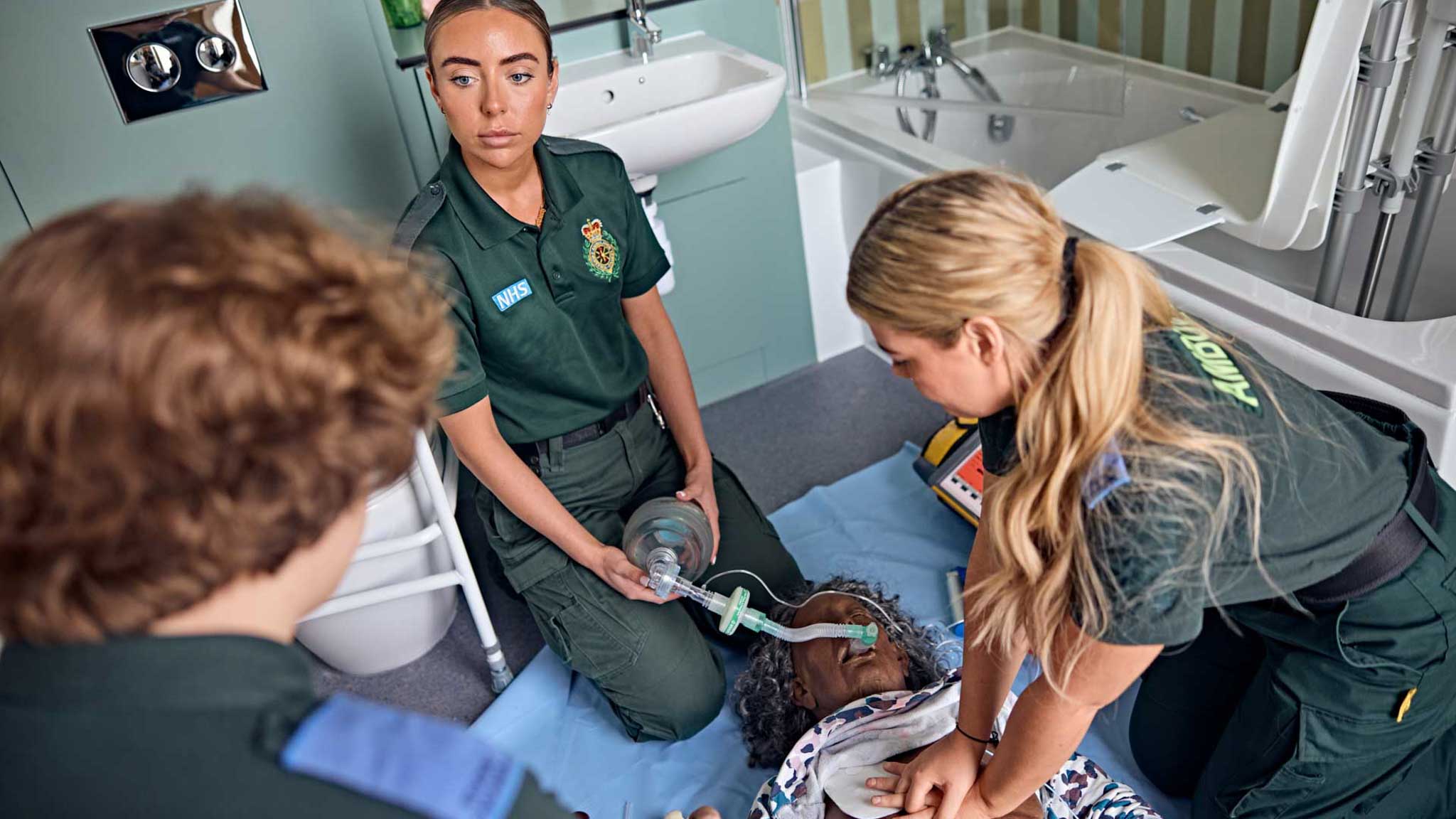
Simulation of cardiac arrests in confined spaces.
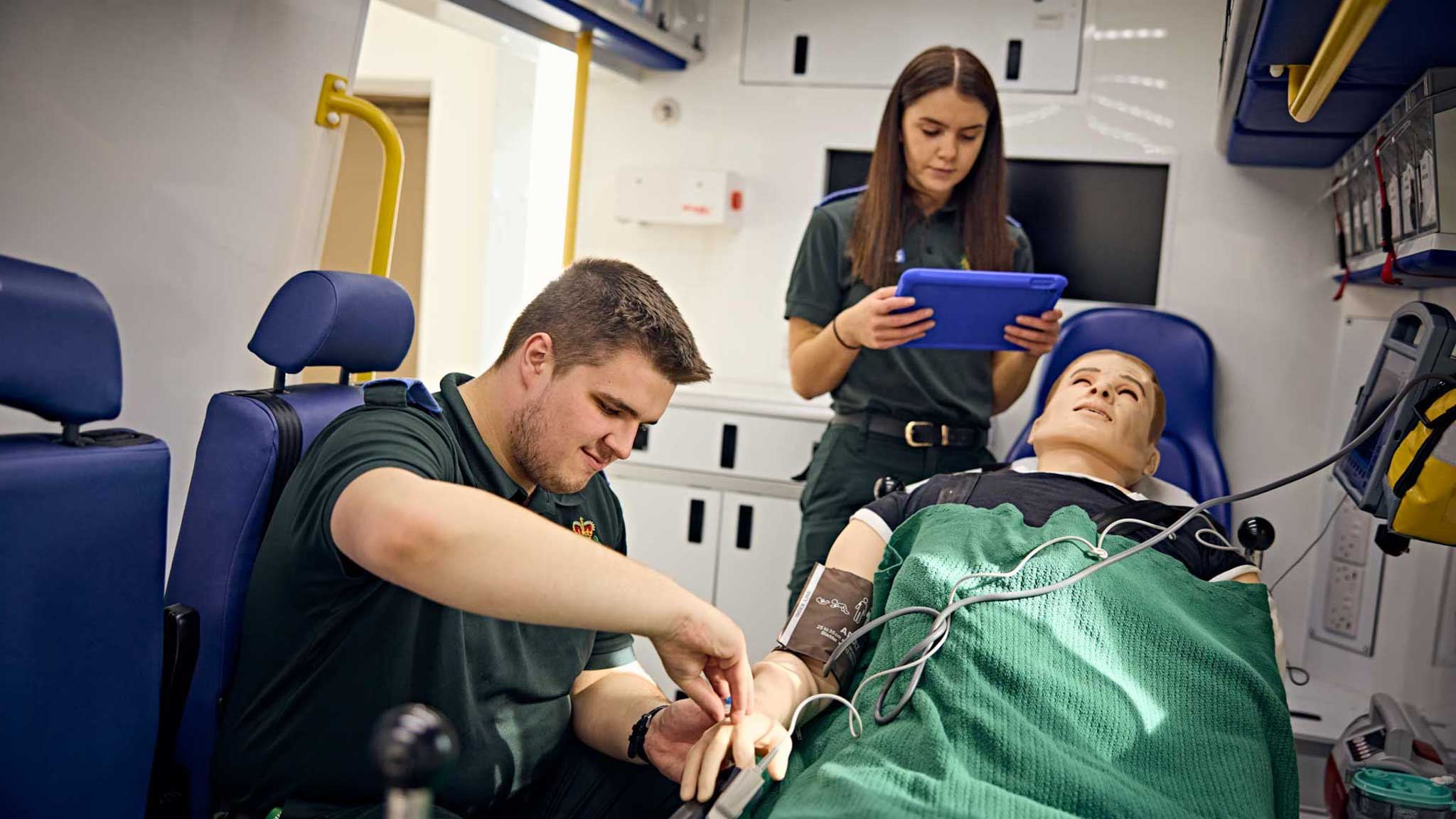
Practicing clinical skills inside the simbulance.
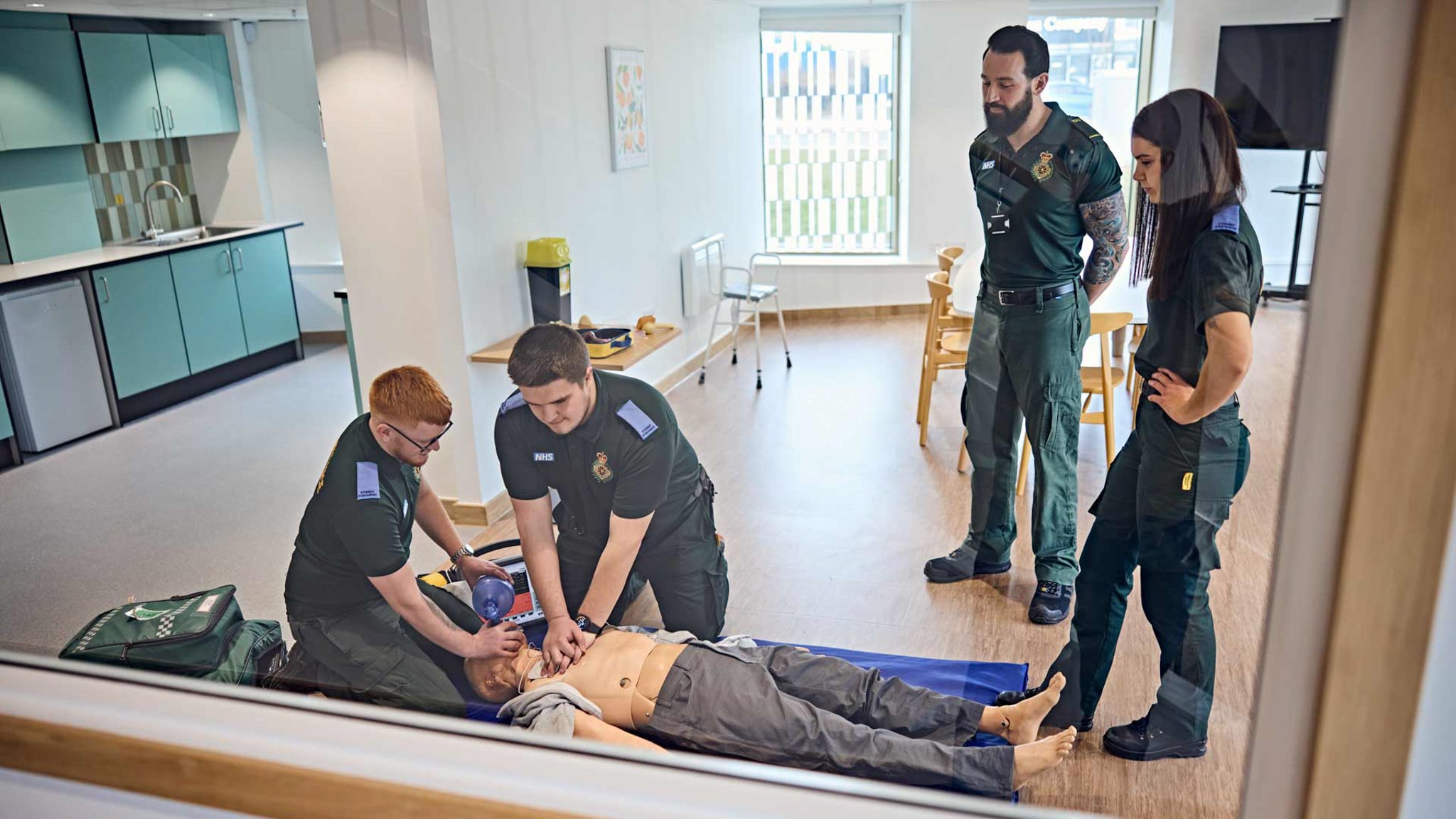
Simulated house with viewing facilities.

Technology simulates patient deterioration.
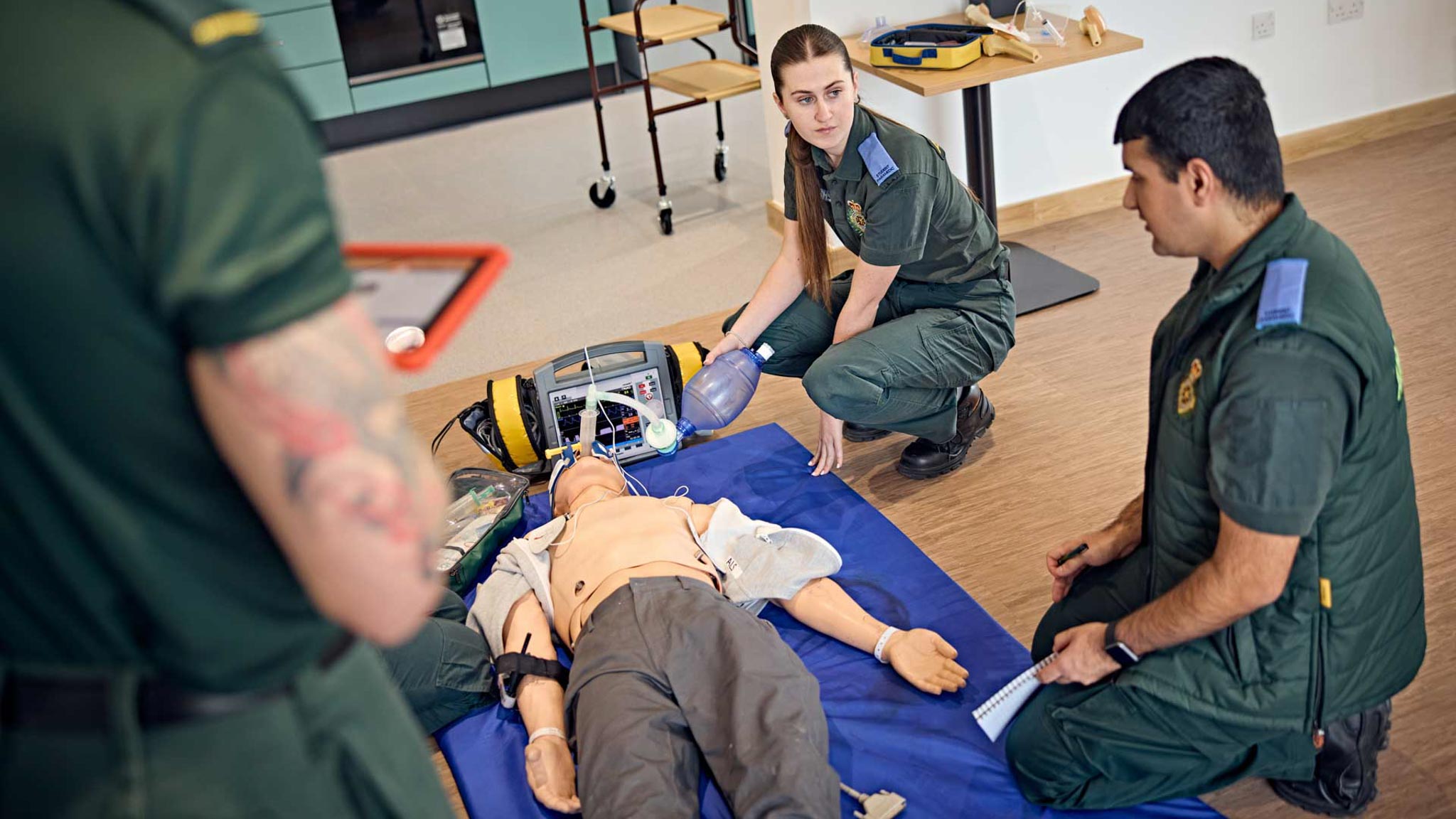
Peer-led assessment learning fosters collaboration
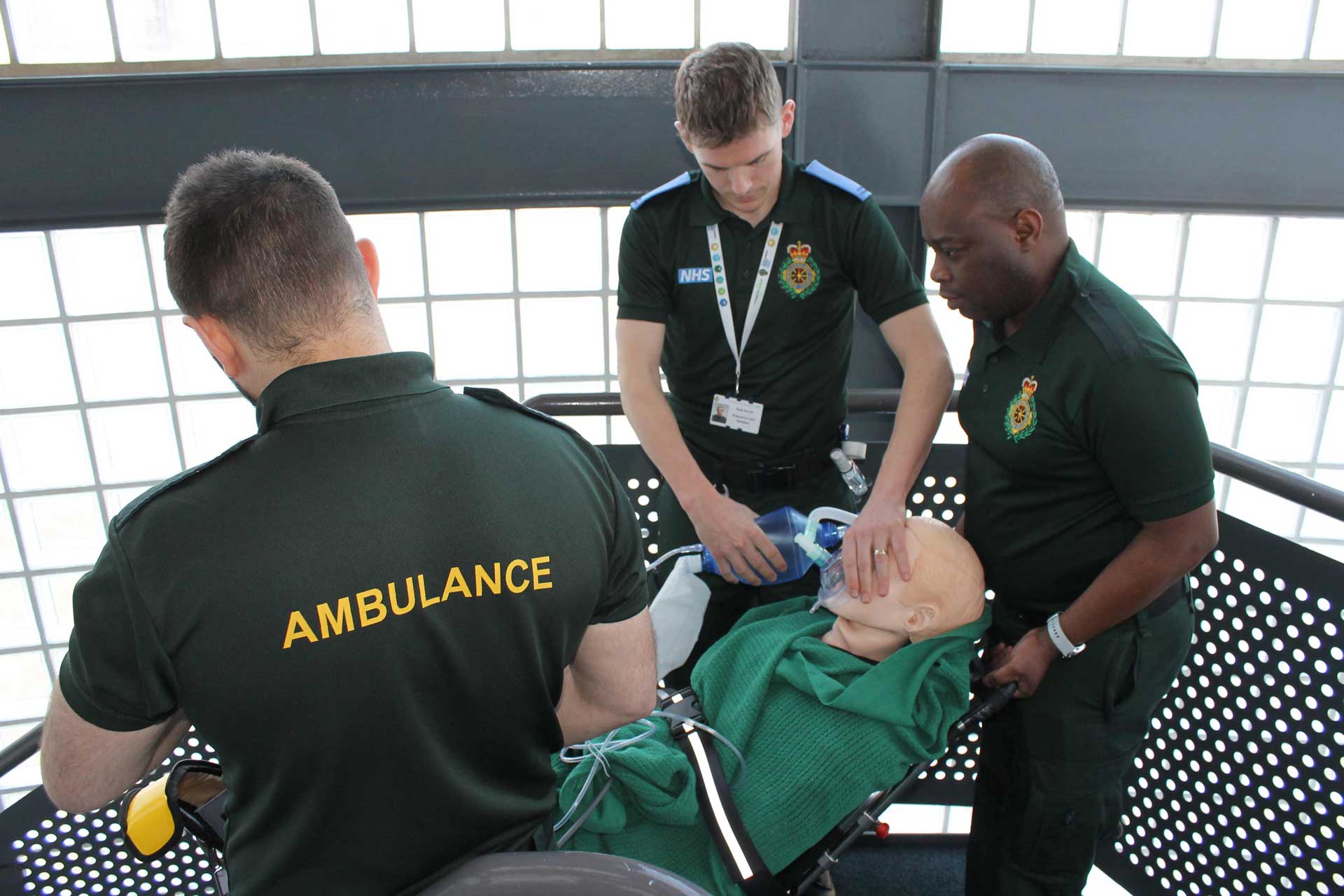
Extrication simulation using carry chair.
Explore More

Award Winning Degree Apprenticeships
The University of Huddersfield has been recognised for excellence in work-based learning and strong industry partnerships.

Ofsted Outstanding courses
Huddersfield is one of only two universities in four years rated Ofsted Outstanding for apprenticeships, praised for research-informed teaching and strong employer links.

Student Support
At the University of Huddersfield, you’ll find services and support networks to help you get ahead in your studies and social life.
Why Hud
Explore the unique opportunities and resources that make our institution a top choice for students seeking a well-rounded and future-focused education.

Explore Huddersfield
Make Huddersfield your home. A Yorkshire town, surrounded by beautiful countryside, with easy access to neighbouring cities; Leeds, Manchester and Sheffield. You’ll find plenty of places to eat, drink, shop and socialise, there’s ambitious plans for future development. Our campus is situated next to the town centre - making your commute a breeze.
Find out more
Your Student Experience
Get involved in great opportunities helping you to make friends from all across the world and create lifelong memories. Join one of over 100 societies with the Students’ Union, experience new cultures through global events, earn whilst you learn and build your skills via our Global Professional Award.
Learn more
Budget Friendly
Huddersfield is not only one of the friendliest towns, it also offers you a lower cost of living than most big cities. This means you could have more money to spend, making your uni experience even better. On campus you’ll also find plenty of facilities and services to help you budget and make your money go further.
Find out more
Sustainability Matters
We’re committed to sustainability and aim to be carbon neutral by 2030. Our plan includes reducing emissions, enhancing biodiversity, and improving wellbeing through sustainable buildings. We’re investing in digital solutions, low-impact travel, and embedding sustainability into teaching and research, investing over £1m in carbon reduction.
Find out more
Committed to Your Future
Since 2015, we’ve invested £198 million to create spaces where you can learn, collaborate and thrive. We’re continuously investing in our campus with your wellbeing in mind—adding features that make our buildings healthier, more supportive and better places for you to succeed.
Read moreMore Info
Careers support
We know you’re coming to university to study on your chosen subject, meet new people and broaden your horizons. However, we also help you to focus on life after you have graduated to ensure that your hard work pays off and you achieve your ambition.
Find out more about careers supportStudent support
At the University of Huddersfield, you’ll find support networks and services to help you get ahead in your studies and social life. Whether you study at undergraduate or postgraduate level, you’ll soon discover that you’re never far away from our dedicated staff and resources to help you to navigate through your personal student journey.
See our support servicesTeaching Excellence
Great teaching is engaging and inspiring — it helps you reach your full potential and prepares you for the future. We don’t just teach well — we excel — and we have the awards and recognition to prove it.
Inspiring Academics
Our researchers carry out world-leading work that makes a real difference to people’s lives. Staff within the Department of Allied Health Professions, Sport and Exercise may teach you on this course.
Find out more about our staffResearch Excellence
You’ll be taught by staff who want to support your learning and share the latest knowledge and research.
Accommodation
Looking for student accommodation? Huddersfield has you covered. HudLets has a variety of accommodation types to choose from, no matter what your preference. HudLets is the University’s approved accommodation service, run by Huddersfield Students’ Union.
Take a look at your optionsFurther Study
If you want to continue your learning beyond your undergraduate degree, there is a range of financial support available for postgraduate study, including discounts for Huddersfield graduates.
Discover postgraduate coursesLoading...
Legal information
When you enrol as an apprentice learner of the University, your study and time with us will be governed by a framework of regulations, policies and procedures, which form the basis of your agreement with us. These include regulations regarding the assessment of your course, academic integrity, your conduct (including attendance) and our disciplinary procedure. It is important that you familiarise yourself with these as you’ll be asked to agree to them when you join us as an apprentice. You’ll find a guide to the key terms here, along with the Student Protection Plan, where you’ll also find links to the full text of each of the regulations, policies and procedures referred to.
Although we always try and ensure we deliver our courses as described, sometimes we may have to make changes for the following reasons:
Changes to a course you have applied for but not yet started
If we propose to make a major change to an apprenticeship course that you have applied for, then we will tell you and your employer as soon as possible so that you can decide whether to withdraw your application prior to enrolment.
Although we always try and run all the courses we offer, we may occasionally have to withdraw a course you have applied for or delay your course start date if we consider this reasonably necessary, for example if there are not enough applicants to ensure you have a good learning experience. Where this is the case we will notify you and your employer as soon as reasonably possible. In such instances, we will work with you and your employer to agree a deferred start date, or cancel your application and, if appropriate, provide information regarding other local apprenticeship providers.
Changes to your course after you enrol as an apprentice
We will only make major changes to the core curriculum of a course or to our services if it is necessary for us to do so and provided such changes are reasonable. A major change is a change that materially changes the services available to you, or the outcomes, or a significant part, of your course, such as the nature of the award or a substantial change to module content, teaching days, classes, type of delivery or assessment of the core curriculum.
For example, it may be necessary to make a major change to reflect changes in the law or the requirements of the University’s regulators; to meet the requirements of an updated version of the apprenticeship standard relevant to your course; to meet the latest requirements of a commissioning or accrediting body; to improve the quality of educational provision; in response to student, examiners’ or other course evaluators’ feedback; and/or to reflect academic or professional changes within subject areas. Major changes may also be necessary because of circumstances outside our reasonable control, such as damage or interruption to buildings, facilities or equipment.
In exceptional circumstances, we may, for reasons outside of our control, be forced to discontinue or suspend your course. Where this is the case, a formal exit strategy will be followed and we will notify you and your employer as soon as possible about what your options are, which may include being provided with individual teaching to complete the award for which you were registered or claiming an interim award and exiting the University.
If a major change affects your course, we will notify you and your employer as soon as possible and will carry out suitable consultation with affected apprentices. If you and your employer reasonably believe that the proposed change will cause you detriment we will work with both of you to try to find an appropriate solution. Where one cannot be found we will provide reasonable support to assist you with transferring your remaining apprenticeship learning to another training provider if you and your employer wish to do so.
Termination of employment
As your employer is funding your apprenticeship course, you must remain in relevant employment for the duration of the course until you have completed your end point assessment. Under the apprenticeship rules, if you are made redundant and you have completed 75% of the practical period or have less than 6 months left, then you may complete the course. Otherwise, unless you find alternative relevant employment within 12 weeks of the date you are made redundant, then you’ll be withdrawn from the course.
The Office for Students (OfS) is the principal regulator for the University. The ESFA is the principal regulator for your apprenticeship course.