
Applications for September 2026 are now closed.
Open to other course options? We can still help you find your place with us.
Alternatively, if you're interested in studying this course in September 2027, please view the 2027-28 course information.
Operating Department Practice BSc(Hons)
Start Dates
21 September 2026
Duration
3 years full-time
UCAS Tariff
112-104 points

Overview
Why choose Huddersfield for this course?
- Gain confidence using our state-of-the-art skills labs and immersive simulation facilities on our National Health Innovation Campus.
- You’ll learn from experienced health professionals and service users whose real-world insights bring teaching to life.
- Build communication, leadership and teamwork skills through our Health and Wellbeing Academy’s community-focused work experience opportunities.
Accreditation and Professional Links
Recognised connections to give you an extra edge when you graduate.
Keen to work in a dramatic and exciting environment?
Operating Department Practitioners (ODPs) work alongside surgeons, anaesthetists, and other medical staff, to provide care for patients during surgery. A role within perioperative practice, therefore, will see you work as part of a dynamic team in an operating theatre and could prove a great career choice.
On our Operating Department Practice BSc(Hons) course, you’ll benefit from a strong grounding in the theory, exploring what’s involved in the three, interconnected aspects of the role: anaesthetic, surgical and post anaesthetic.
Why study Operating Department Practice BSc(Hons)
On this course, you’ll have the opportunity to practise your skills in our simulated operating theatre, enabling you to experience the operating theatre environment.
This course is regulated by the Health and Care Professions Council (HCPC), which means you’ll benefit from experienced staff, specialist skills labs and great links to NHS Trusts and our partners in the private sector. Our clinical placement opportunities enable you to gain valuable hands-on experience in perioperative environments, as well as potentially shadowing an operating department practitioner as part of interdisciplinary teams in a variety of care settings. This will allow you to see how ODPs contribute to all sorts of specialist areas in real world environments.
Also, our Public Partnership Group (PPG) and Health and Wellbeing Academy work together to support your development as a compassionate, person-centred professional. You’ll engage with service users and carers through lectures, discussions, and simulations. Their lived experiences will help to build your communication skills, empathy, and the critical thinking needed to deliver outstanding care across diverse communities. While our Health and Wellbeing Academy offers hands-on placement opportunities through initiatives like Get Set Goal and Restart a Heart. These experiences will help you build skills in communication, public health, leadership, and teamwork while making a real impact in the community.
On our Operating Department Practice course:
-
You’ll receive support during your studies from academic staff and qualified practitioners who understand what it’s like to be an ODP.
-
You’ll move beyond the fundamentals, as the course progresses, to delve into the role research plays in perioperative practice and explore leadership and management strategies.
-
You’ll experience the University’s new Daphne Steele Building, which is now open on the site of the National Health Innovation campus. This allows our Operating Department Practice BSc(Hons) students to benefit from specialist clinical teaching facilities and world-leading research facilities, helping you boost your skills within the health sector and preparing you for a potentially rewarding career ahead.
Students on this course may be eligible to receive a non-repayable grant of at least £5,000 each year – find out more on the NHS Learning Support Fund website.
Not quite ready to start Operating Department Practice BSc(Hons)? Successful completion of our Health Foundation Pathway leading to a BSc(Hons) Degree will equip you with the foundation knowledge to study Operating Department Practice.

Entry Requirements
To find out if you're eligible to start this course in September {{ this_year }} and get more information on how to apply, please see our Clearing pages or call our Clearing Helpline on 0333 987 9000.
Please note that some of our courses have additional non-academic requirements, such as Disclosure and Barring Service (DBS), Occupational Health, or Overseas Police checks. If any of these are required, further details will be provided if you receive an offer.
If English is not your first language, you will need to meet the minimum requirements for an accepted English language qualification. If this applies to you, we will contact you to request the relevant information.
If you're interested in studying this course in September {{ next_year }}, please view the {{ next_year_of_entry }} course information.
Course Details
Teaching and Assessment
Discover what to expect from your tutor contact time, assessment methods, and feedback process.
Global Professional Award
At Huddersfield, you’ll study the award-winning Global Professional Award (GPA) alongside your degree* — so you’re ready for the career you want, whatever subject you choose.
Placements
Clinical placements are a compulsory element of the course and these will be undertaken in a range of settings. This provides a number of opportunities for you to develop the required clinical skills and experience a variety of placements and the diversity of procedures in the perioperative environment.
These placements which will be allocated by the University, will be undertaken in up to two or three different hospitals. As placements are undertaken in the hospitals listed below you must be prepared to travel to any or all of these.
- Airedale General Hospital
- Bradford Teaching Hospital
- Calderdale Royal Hospital
- Dewsbury and District Hospital
- Harrogate District Hospital
- Huddersfield Royal Infirmary
- Leeds Teaching Hospital including Leeds General Infirmary, St James’ University Hospital, Chapel Allerton Hospital and Wharfedale Hospital
- Pinderfields Hospital
- Pontefract Hospital
Placements are also undertaken in some private hospitals including BMI The Duchy Hospital Harrogate, Huddersfield BMI, Leeds Nuffield, Spire Elland and Spire Leeds, Spire Methley Park and the Yorkshire Clinic.
Travelling to Placement
You will undertake placements as part of your course, which may take place across a wide geographical area. Wherever possible, we will not expect students to travel for longer than two hours each way from the University campus. However, if a student chooses to live outside the region of the hospitals mentioned above, it may not be possible to apply the two-hour travel time limit.
Also, our Health and Wellbeing Academy offers hands-on placement opportunities through initiatives like Get Set Goal and Restart a Heart. These experiences will help you build skills in communication, public health, leadership, and teamwork while making a real impact in the community.
Your Career
Recent graduates from this course have become theatre practitioners in NHS hospitals. Other opportunities may include roles as perioperative practitioners, specialist practitioners, team leaders, managers, educators and academics both in clinical settings and universities, as well as working in other areas where critically ill patients are cared for. The course enables graduates to apply for Health and Care Professions Council (HCPC) registration and then work as a perioperative practitioner.
80% Graduates from this course were in work or further study 15 months after graduation.
* HESA Graduate Outcomes 21/22, UK Domiciled
You go to a different hospital trust each year, where you gain knowledge from different practitioners from a variety of backgrounds. This helps to perfect your own practice and provides an insight into a wide variety of surgical specialities. You start with simple operations and over the three years as you gain knowledge and experience you build your way up to more complex cases.
- Alex Renshaw
Graduated Operating Department Practice BSc(Hons), now an Operating Department Practitioner at Nottingham University Hospitals Trust.
Fees and Finance
This information is for Home students applying to study at the University of Huddersfield in the academic year 2026/27.
Please note that tuition fees for subsequent years may rise in line with inflation (RPI-X) and/or Government policy.
From January 2027 the UK government is launching a new student funding system for people starting university education. Read more about the Lifelong Learning Entitlement (LLE).
For detailed information please visit our fees page.
This information is for international students applying to study at the University of Huddersfield in the academic year 2026/27.
Please note that tuition fees for subsequent years may rise in line with inflation (RPI-X) and/or Government policy.
For detailed information please visit our international fees and funding page.
Placement Funding:
Throughout your studies placements may incur additional costs for accommodation, parking and travel. You may be able to claim costs back through the Learning Support Fund (LSF).
We strongly encourage you to read the information available on the NHS Learning Support Fund Website to understand your eligibility and how the LSF works.
Uniform:
Students receive an initial set of uniforms required for placement. After these have been issued, any additional uniforms may incur a cost. In 2025/26, one extra set costs approximately £30
Students studying eligible courses may receive a non-repayable grant of at least £5,000 per year.
Scholarships and Bursaries
Discover what additional help you may be eligible for to support your University studies.
Tuition Fee Loans
Find out more about tuition fee loans available to eligible undergraduate students.
What’s included in your fee?
We want you to understand exactly what your fees will cover and what additional costs you may need to budget for when you decide to become a student with us.
If you have any questions about Fees and Finance, please email the Student Finance Team.
Gallery
Simulated operating theatre.

Clinical session: airway management techniques.
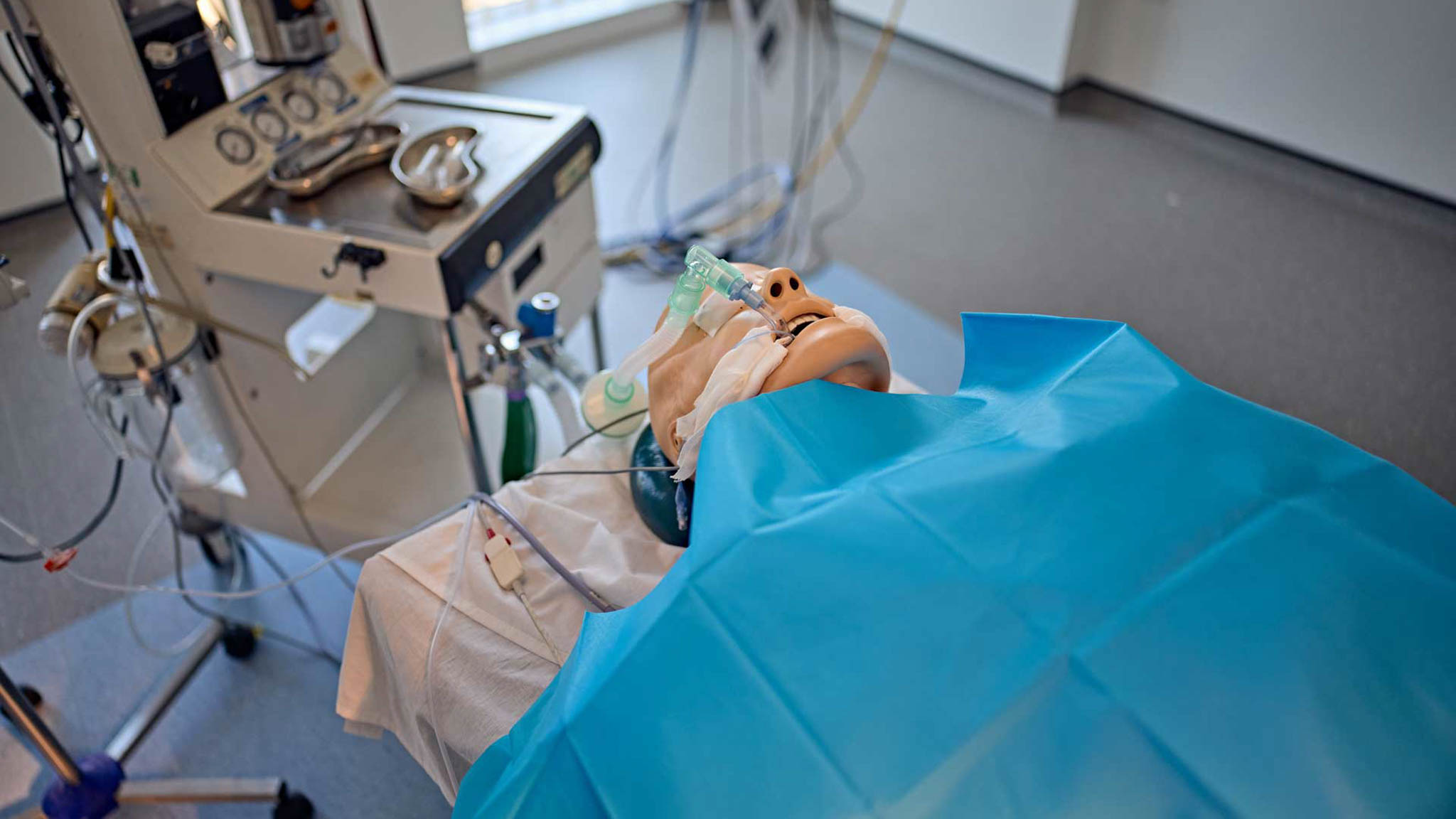
Students practise skills on simulation mannequins.

Student practising surgical scrub techniques.

Students are caring for a simulated patient.
Explore More

Patient, Service User and Carer involvement
Our Public Partnership Group (PPG) is committed to helping students become a compassionate, person-centred professionals. Students can engage with service users and carers through lectures, discussions, and simulations. Their lived experiences will help to build students communication skills, empathy, and the critical thinking needed to deliver outstanding care across diverse communities.

Health and Wellbeing Academy
Our Health and Wellbeing Academy offers healthcare students hands-on placement opportunities through initiatives like Get Set Goal and Restart a Heart. These experiences help students build skills in communication, public health, leadership, and teamwork while making a real impact in the community.
Why Hud
Explore the unique opportunities and resources that make our institution a top choice for students seeking a well-rounded and future-focused education.

Explore Huddersfield
Make Huddersfield your home. A Yorkshire town, surrounded by beautiful countryside, with easy access to neighbouring cities; Leeds, Manchester and Sheffield. You’ll find plenty of places to eat, drink, shop and socialise, there’s ambitious plans for future development. Our campus is situated next to the town centre - making your commute a breeze.
Find out more
Your Student Experience
Get involved in great opportunities helping you to make friends from all across the world and create lifelong memories. Join one of over 100 societies with the Students’ Union, experience new cultures through global events, earn whilst you learn and build your skills via our Global Professional Award.
Learn more
Budget Friendly
Huddersfield is not only one of the friendliest towns, it also offers you a lower cost of living than most big cities. This means you could have more money to spend, making your uni experience even better. On campus you’ll also find plenty of facilities and services to help you budget and make your money go further.
Find out more
Sustainability Matters
We’re committed to sustainability and aim to be carbon neutral by 2030. Our plan includes reducing emissions, enhancing biodiversity, and improving wellbeing through sustainable buildings. We’re investing in digital solutions, low-impact travel, and embedding sustainability into teaching and research, investing over £1m in carbon reduction.
Find out more
Committed to Your Future
Since 2015, we’ve invested £198 million to create spaces where you can learn, collaborate and thrive. We’re continuously investing in our campus with your wellbeing in mind—adding features that make our buildings healthier, more supportive and better places for you to succeed.
Read moreMore Info
Careers support
We know you’re coming to university to study on your chosen subject, meet new people and broaden your horizons. However, we also help you to focus on life after you have graduated to ensure that your hard work pays off and you achieve your ambition.
Find out more about careers supportStudent support
At the University of Huddersfield, you’ll find support networks and services to help you get ahead in your studies and social life. Whether you study at undergraduate or postgraduate level, you’ll soon discover that you’re never far away from our dedicated staff and resources to help you to navigate through your personal student journey.
See our support servicesTeaching Excellence
Great teaching is engaging and inspiring — it helps you reach your full potential and prepares you for the future. We don’t just teach well — we excel — and we have the awards and recognition to prove it.
Inspiring Academics
Our researchers carry out world-leading work that makes a real difference to people’s lives. Staff within the Department of Allied Health Professions, Sport and Exercise may teach you on this course.
Find out more about our staffResearch Excellence
You’ll be taught by staff who want to support your learning and share the latest knowledge and research.
Accommodation
Looking for student accommodation? Huddersfield has you covered. HudLets has a variety of accommodation types to choose from, no matter what your preference. HudLets is the University’s approved accommodation service, run by Huddersfield Students’ Union.
Take a look at your optionsFurther Study
If you want to continue your learning beyond your undergraduate degree, there is a range of financial support available for postgraduate study, including discounts for Huddersfield graduates.
Discover postgraduate coursesLoading...
Legal information
When you enrol as a student of the University, your study and time with us will be governed by our terms and conditions, Handbook of Regulations and associated policies. It is important that you familiarise yourself with these as you will be asked to agree to them when you join us as a student. You will find a guide to the key terms here, along with the Student Protection Plan.
Although we always try and ensure we deliver our courses as described, sometimes we may have to make changes for the following reasons:
Changes to a course you have applied for but are not yet enrolled on
If we propose to make a major change to a course that you are holding an offer for, then we will tell you as soon as possible so that you can decide whether to withdraw your application prior to enrolment. We may occasionally have to withdraw a course you have applied for or combine your programme with another programme if we consider this reasonably necessary to ensure a good student experience, for example if there are not enough applicants. Where this is the case we will notify you as soon as reasonably possible and if you are unhappy with the change we will discuss with you other suitable courses we can transfer your application to. If you do not wish to transfer to another course with us, you may cancel your application and we will refund you any deposits or fees you have paid to us.
Changes to your course after you enrol as a student
Changes to option modules
Where your course allows you to choose modules from a range of options, we will review these each year and change them to reflect the expertise of our staff, current trends in research and as a result of student feedback or demand for certain modules. We will always ensure that you have an equivalent range of options to that advertised for the course. We will let you know in good time the options available for you to choose for the following year.
Major changes
We will only make major changes to non-optional modules on a course if it is necessary for us to do so and provided such changes are reasonable. A major change is a change that substantially changes the outcomes, or a significant part of your course, such as the nature of the award or a substantial change to module content, teaching days (part time provision), type of delivery or assessment of the core curriculum. For example, it may be necessary to make a major change to reflect changes in the law or the requirements of the University’s regulators or a commissioning or accrediting body. We may also make changes to improve the course in response to student, examiners’ or other course evaluators’ feedback or to ensure you are being taught current best practice. Major changes may also be necessary because of circumstances outside our reasonable control, such as a key member of staff being unable to teach due to illness, where they have a particular specialism that can’t be adequately covered by other members of staff; or due to pandemics, other disasters (such as fire, flood or war) or changes made by the government.
Major changes would usually be made with effect from the next academic year, but may happen sooner in an emergency. We will notify you as soon as possible should we need to make a major change and will consult with affected groups of students and any changes would only be made in accordance with our regulations. If you reasonably believe that the proposed change will cause you detriment or hardship we will, if appropriate, work with you to try to reduce the adverse effect on you or find an appropriate solution. Where an appropriate solution cannot be found and you let us know before the change takes effect you can cancel your registration and withdraw from the University without liability to the University for any additional tuition fees. We will provide reasonable support to assist you with transferring to another university if you wish to do so and you may be eligible for an exit award depending on how far through your course you are.
In exceptional circumstances, we may, for reasons outside of our control, be forced to discontinue or suspend your course. Where this is the case, a formal exit strategy will be followed in accordance with the student protection plan.
The Office for Students (OfS) is the principal regulator for the University.